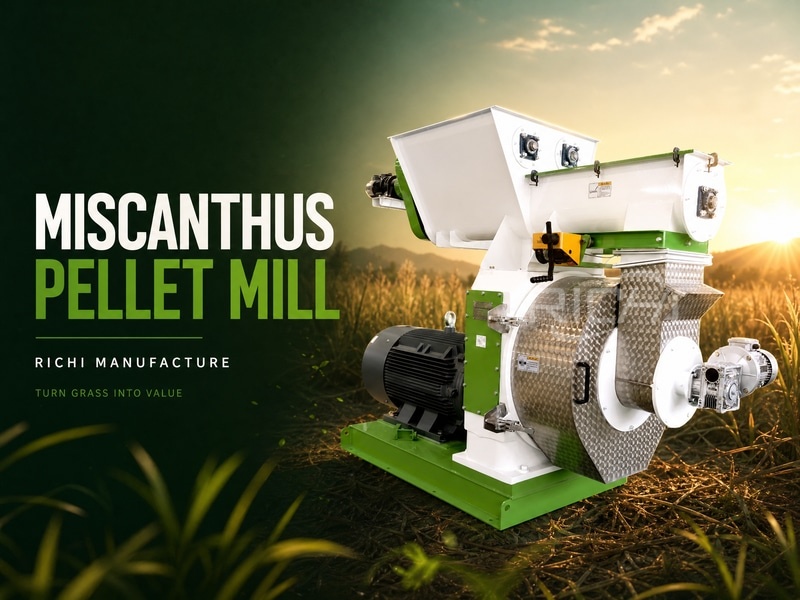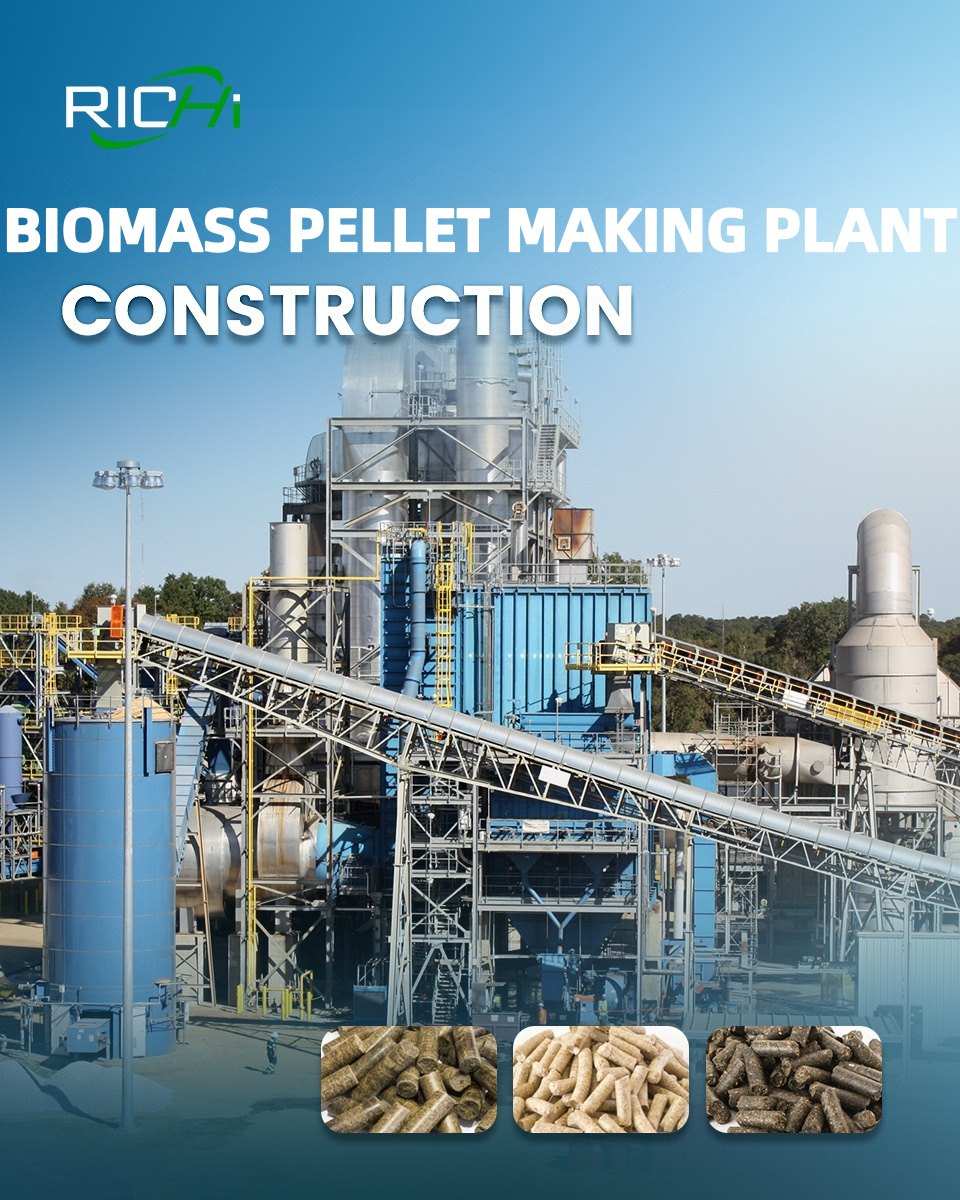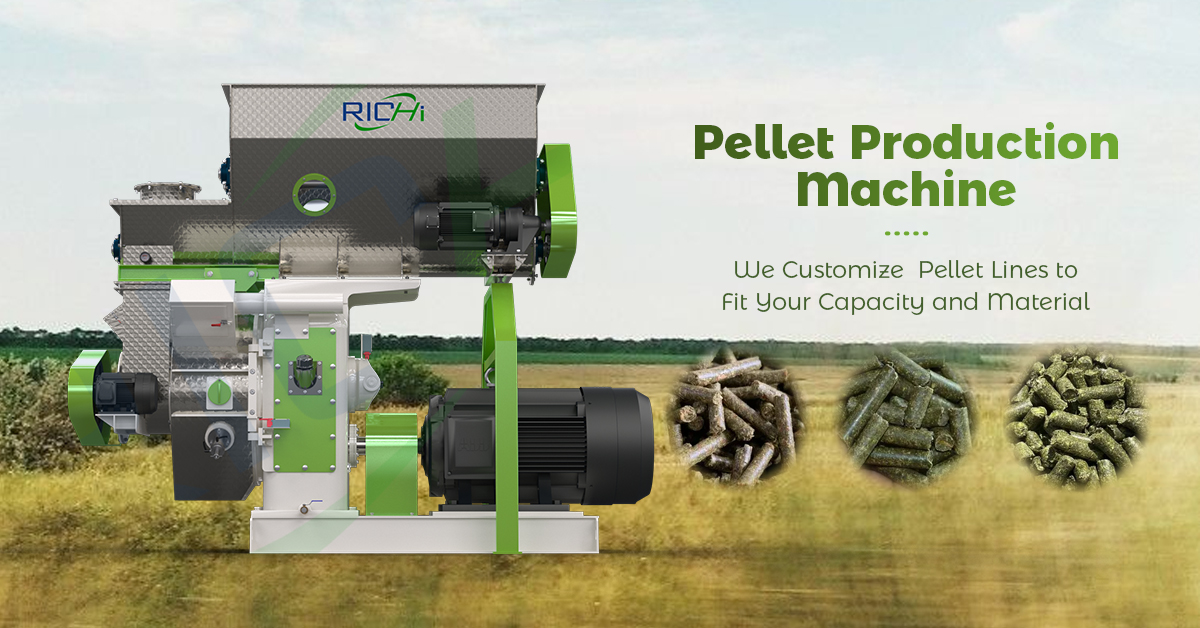

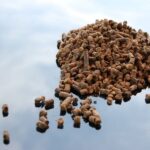

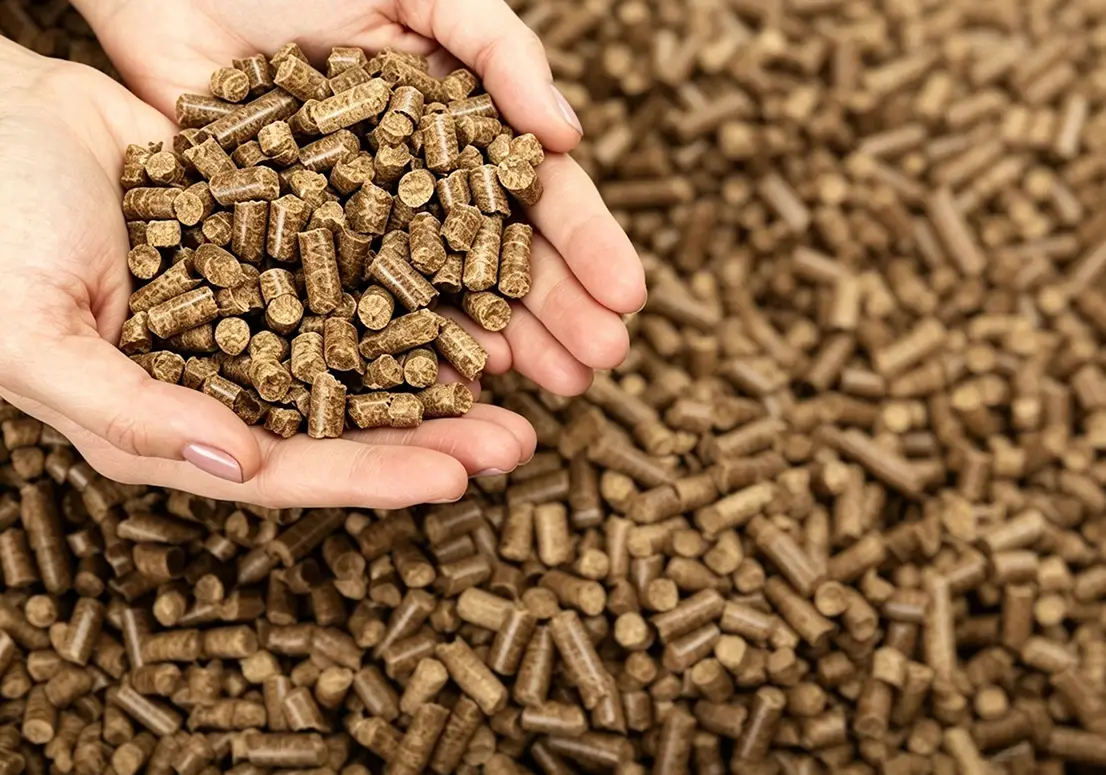
Empty fruit bunches, commonly known as EFB, are one of the major biomass residues generated by palm oil mills. After fresh fruit bunches are processed for palm oil extraction, large quantities of EFB remain. Because EFB contains valuable fibrous biomass, it can be processed into fuel pellets and used as a renewable energy resource.
However, raw EFB is not normally suitable for direct pelletizing. Fresh or poorly prepared EFB can contain excessive moisture, long fibers, large pieces, soil, sand, metal, and other foreign materials. Its irregular structure can also make feeding and compression difficult.
Proper preparation before pelletizing is therefore essential. The objective is to transform bulky and inconsistent EFB into a cleaner, more uniform, and appropriately conditioned feedstock for the pellet mill.
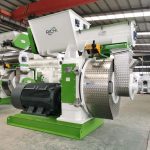
An EFB pellet processing machine can be used as part of this preparation system. Depending on the project, the complete pretreatment section may include cleaning equipment, shredders, crushers, dryers, grinders, magnetic separators, conveyors, and feeding systems.
This article explains how to prepare EFB before pelletizing and why each preparation step matters.
Why Does EFB Need Pretreatment?
EFB has several characteristics that can create challenges during pellet production.
Raw EFB may have:
- High moisture content
- Long and tangled fibers
- Large irregular pieces
- Variable particle size
- Low bulk density
- Sand and soil contamination
- Metal or other foreign materials
If this material is fed directly into a pellet mill, several problems may occur.
The pellet mill may experience unstable feeding, die blockage, excessive power consumption, uneven pellet density, high fines, or accelerated wear.
Pretreatment solves these problems by improving the physical characteristics of EFB before compression.
The basic principle is:
Raw EFB → Cleaner EFB → Smaller EFB → Drier EFB → More Uniform EFB → Pelletizing
Step 1: Evaluate the Raw EFB
Before choosing processing equipment, the characteristics of the available EFB should be tested.
Important parameters include:
- Initial moisture content
- Particle size
- Fiber length
- Bulk density
- Ash or contamination level
- Daily EFB supply
- Storage conditions
The initial moisture level is particularly important because it determines the required drying capacity.
The amount of EFB available also determines the required capacity of the pretreatment system.
For example, a small biomass project and a large palm oil mill may require completely different equipment configurations.
Therefore, the EFB preparation system should be designed according to actual feedstock conditions rather than based only on standard equipment specifications.
Step 2: Remove Foreign Materials
Cleaning is the first major step in EFB preparation.
Depending on how EFB is collected and transported, it may contain:
- Stones
- Sand
- Soil
- Metal
- Plastic
- Other processing residues
These contaminants can reduce the quality of the final pellets and damage processing equipment.
Why Cleaning Matters
Hard contaminants can enter shredders, crushers, grinders, and pellet mills.
Stones and metal can cause serious mechanical damage.
Soil and sand can also increase ash content in the finished biomass fuel.
Therefore, a cleaning system should be installed before intensive size reduction.
Depending on the project, cleaning may involve screening, magnetic separation, air separation, or other material separation methods.
Step 3: Remove Metal Contaminants
Metal contamination deserves special attention.
Small metal pieces may enter EFB during harvesting, transportation, or palm oil mill operations.
If metal reaches the grinder or pellet mill, it can damage knives, hammers, dies, rollers, bearings, and other components.
A magnetic separator can be installed in an appropriate position in the material-handling system.
Removing ferrous metals before grinding helps protect expensive processing equipment and reduces unexpected downtime.
Step 4: Shred Long EFB Fibers
One of the most important characteristics of EFB is its fibrous structure.
Raw EFB can contain long, tangled fibers that are difficult to feed into a pellet mill.
A shredder or coarse crushing machine can reduce the length of these fibers.
The purpose of shredding is not necessarily to create a fine powder.
Instead, it is intended to:
- Break large EFB pieces
- Shorten long fibers
- Improve material flow
- Increase surface area
- Prepare the material for drying
- Make subsequent grinding easier
After shredding, the EFB becomes easier to transport through conveyors and processing equipment.
Step 5: Improve Material Uniformity
Raw EFB can have a wide range of particle sizes.
Some pieces may be large bunch fragments, while others may already consist of small fibers.
This variation can make drying and grinding less consistent.
The pretreatment system should gradually reduce these differences.
A coarse crusher or shredder can first break down large pieces, followed by finer grinding.
This staged approach is generally more practical than trying to grind large EFB pieces directly into fine particles in one step.
Step 6: Dry the EFB
Drying is one of the most important stages before pelletizing.
Fresh EFB may contain considerable moisture.
If moisture is too high, the material may not form strong pellets efficiently.
Excessive moisture can also increase energy consumption and make pellet mill operation unstable.
Therefore, the EFB should normally be dried to a suitable moisture condition before pelletizing.
Why Moisture Control Is Important
Moisture affects:
- Pellet durability
- Pellet density
- Pellet formation
- Energy consumption
- Die performance
- Production stability
The objective is not simply to make EFB as dry as possible.
Over-drying can also increase energy consumption and may negatively affect pellet formation.
The better approach is to achieve a suitable and consistent moisture level for the specific EFB pelletizing process.
Step 7: Use a Rotary Dryer
An industrial rotary dryer machine is commonly used for continuous biomass drying.
It can handle large quantities of EFB and reduce moisture before grinding and pelletizing.
The drying system should be selected according to:
- Initial moisture
- Required final moisture
- EFB throughput
- Heat source
- Available installation space
- Energy requirements
Proper airflow and residence time are important for uniform drying.
A poorly designed dryer may leave some EFB too wet while over-drying other material.
This can cause instability when the material reaches the pellet mill.
Step 8: Monitor Moisture After Drying
Moisture should be checked after the drying process.
A moisture monitoring system can help operators identify changes in raw material conditions.
If the incoming EFB becomes wetter, the dryer may need to operate differently.
If the material becomes drier, excessive heating should be avoided.
Consistent moisture improves the stability of the downstream grinding and pelletizing process.
Step 9: Crush the Dried EFB
After drying, the EFB may need additional crushing.
The purpose of this stage is to reduce the material to a size that is more suitable for fine grinding and pelletizing.
A hammer mill or other suitable biomass crusher can be used depending on the material characteristics.
Proper crushing helps:
- Reduce oversized particles
- Improve particle uniformity
- Increase grinding efficiency
- Improve pellet formation
- Reduce the risk of die blockage
Step 10: Fine Grinding
Fine grinding is the next important stage.
The pellet mill performs best when it receives relatively uniform feedstock.
A hammer mill can reduce EFB into smaller particles.
The exact particle size should depend on:
- Pellet diameter
- Die hole design
- Compression ratio
- EFB fiber characteristics
- Required pellet quality
The objective is to achieve suitable particle size without wasting excessive electricity on unnecessary grinding.
Should EFB Be Ground Into Powder?
Not necessarily.
A common misunderstanding is that biomass must be ground into extremely fine powder before pelletizing.
In practice, excessively fine grinding can increase energy consumption without producing a proportional improvement in pellet quality.
The goal is to achieve particles that can enter the die holes and form stable pellets.
The optimal particle size should therefore be determined according to the actual EFB and pellet mill configuration.
Step 11: Control Particle Size Distribution
Particle size is not just about average particle size.
The overall particle size distribution is also important.
If a material stream contains too many oversized fibers, the pellet mill may experience unstable compression.
If it contains excessive fines, grinding energy may be unnecessarily high.
A screening system can help separate oversized particles and return them for additional grinding.
This creates a more consistent feedstock for pelletizing.
Step 12: Use an EFB Pellet Processing Machine
The term EFB pellet processing machine can refer to equipment used to process EFB into a form suitable for pelletizing or to equipment integrated into the overall EFB pellet production system.
Depending on the project, the processing system may include:
- EFB shredder
- Crusher
- Rotary dryer
- Hammer mill
- Magnetic separator
- Conveyor
- Dust collection system
- Storage hopper
- Feeding equipment
- Pellet mill
These machines should be selected as a coordinated system.
A high-performance grinder cannot compensate for an undersized dryer, and a high-capacity pellet mill cannot operate efficiently if the feeding system is unstable.
(Learn more: https://richipelletizer.com/efb-pellet-machine/)
Step 13: Improve Bulk Material Flow
After shredding, drying, and grinding, EFB becomes more suitable for mechanical conveying.
However, the material can still be fibrous and lightweight.
Hopper design is therefore important.
A suitable hopper should minimize:
- Material bridging
- Uneven discharge
- Sudden material surges
- Blockages
Agitators or screw feeders can be used when necessary to maintain stable material flow.
Step 14: Prevent Bridging
Bridging occurs when fibrous material forms a structure across a hopper opening.
This can interrupt feeding.
EFB is particularly susceptible to this problem because its fibers can interlock.
Possible solutions include:
- Proper hopper geometry
- Agitators
- Screw feeders
- Vibrating devices
- Anti-bridging equipment
- Controlled feeding systems
Stable material flow is essential because the pellet mill requires a continuous supply of prepared feedstock.
Step 15: Install Dust Collection
Drying, crushing, and grinding can generate dust.
Dust collection is therefore an important part of an industrial EFB pellet production system.
A suitable dust collection system can:
- Improve the working environment
- Reduce airborne dust
- Keep equipment cleaner
- Improve material recovery
- Support safer plant operation
The exact dust-control configuration should be designed according to the equipment layout and local industrial requirements.
Step 16: Store Prepared EFB Properly
If there is a delay between pretreatment and pelletizing, prepared EFB needs to be stored appropriately.
Dried biomass can absorb moisture from humid air.
If the prepared material becomes wet again, the drying process may need to be repeated.
Storage areas should therefore protect material from:
- Rain
- Ground moisture
- Excessive humidity
- Contamination
- Uncontrolled exposure to weather
Proper material handling between processes is just as important as the machines themselves.
Step 17: Avoid Excessive Moisture Reabsorption
One common problem in biomass plants is that material is dried correctly but absorbs moisture again before pelletizing.
This can happen when:
- Dried EFB is stored outdoors
- Conveyors are exposed to rain
- Storage areas have high humidity
- Material remains in storage for too long
The plant layout should therefore minimize unnecessary transportation and storage between drying and pelletizing.
Where practical, dried material can be transferred directly to grinding, feeding, and pelletizing systems.
Step 18: Balance Drying and Grinding
Drying and grinding should be considered together.
Very wet EFB can be difficult to grind efficiently.
After appropriate drying, the material becomes easier to process.
However, excessive drying can waste thermal energy.
Therefore, the preparation line should find a balance between:
Moisture reduction → Grinding efficiency → Pellet quality → Energy consumption
This balance is especially important for large commercial EFB pellet plants.
Step 19: Prepare EFB According to Pellet Size
The final pellet diameter should be considered during pretreatment.
For example, producing smaller pellets may require more consistent particle preparation than producing larger industrial fuel pellets.
The die hole diameter and compression ratio should therefore be considered when determining grinding requirements.
Pretreatment should not be designed independently from the pellet mill.
Instead, the entire process should be planned backward from the required finished pellet specifications.
Step 20: Match Pretreatment Capacity With Pellet Mill Capacity
One of the most common production-line design mistakes is capacity mismatch.
For example, if the pellet mill requires a continuous supply of 5 tons per hour of prepared material, the drying and grinding systems should be able to supply enough material under actual operating conditions.
If the pretreatment system is undersized, the pellet mill may frequently run below its capacity.
If the pretreatment system is excessively oversized, the investment and operating costs may increase unnecessarily.
Therefore, the capacity of each processing stage should be balanced.
Step 21: Control the Quality of Prepared EFB
Before the material enters the pellet mill, operators should check several characteristics.
These may include:
- Moisture content
- Particle size
- Fiber length
- Foreign material content
- Bulk density
- Material temperature
This quality check helps identify problems before they affect pellet production.
For example, if the prepared EFB is too wet, the operator can adjust the dryer before large quantities of unsuitable material reach the pellet mill.
Step 22: Maintain EFB Processing Equipment
The quality of pretreatment depends heavily on equipment condition.
Regular maintenance should cover:
- Shredder knives
- Crusher hammers
- Grinder screens
- Dryer components
- Bearings
- Conveyors
- Feeders
- Magnetic separators
- Dust collection equipment
Worn components can gradually reduce processing performance.
For example, worn grinder hammers may produce an increasingly uneven particle size distribution.
Regular inspection helps maintain consistent preparation quality.
Step 23: Design the Complete EFB Preparation Process
A typical industrial EFB preparation process may look like:
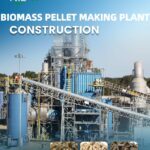
Raw EFB → Cleaning → Magnetic Separation → Shredding → Drying → Crushing → Fine Grinding → Screening → Storage or Feeding → Pelletizing
The exact configuration depends on the raw material.
Some projects may require additional separation or grinding stages, while others may use a simpler process.
The most important principle is that each stage should solve a specific problem associated with the raw EFB.
Common EFB Preparation Problems
EFB Is Too Wet
Possible cause: High initial moisture or insufficient dryer capacity.
Solution: Improve drying capacity and monitor moisture continuously.
Fibers Are Too Long
Possible cause: Inadequate shredding.
Solution: Add or optimize a suitable shredder or coarse crusher.
Particle Size Is Too Large
Possible cause: Insufficient grinding.
Solution: Adjust crusher or hammer mill settings and screen configuration.
Excessive Dust
Possible cause: Excessive grinding or inadequate dust collection.
Solution: Optimize particle size and improve dust-control equipment.
Feeding Is Unstable
Possible cause: Long fibers, poor hopper design, or material bridging.
Solution: Improve material preparation and use an appropriate feeding system.
Prepared Material Becomes Wet Again
Possible cause: Poor storage or excessive exposure to humid conditions.
Solution: Protect dried EFB and minimize the time between drying and pelletizing.
How Proper EFB Preparation Improves Pellet Quality
Proper pretreatment provides several benefits during pelletizing.
Better Pellet Formation
Uniform particles can be compressed more consistently.
Higher Pellet Durability
Appropriate moisture and particle size can improve bonding during compression.
Lower Fines
Stable pellet formation can reduce the amount of broken material.
More Stable Production
Consistent feedstock allows the pellet mill to operate within a more stable load range.
Lower Equipment Wear
Removing contaminants and avoiding oversized particles can reduce mechanical stress.
Better Energy Efficiency
Efficient drying and grinding can reduce unnecessary energy consumption.
How Proper Preparation Improves Pellet Mill Performance
A pellet mill is only as effective as the material supplied to it.
If EFB is wet, oversized, contaminated, or poorly distributed, even a high-quality pellet mill may struggle.
Proper preparation helps the pellet mill by providing:
- More consistent moisture
- More uniform particle size
- Better material flow
- Lower contamination
- More stable feeding
- More predictable compression
This is why EFB pretreatment should be considered an essential part of the pellet production process rather than an optional step.
Selecting an EFB Pellet Processing System
When choosing an EFB pellet processing machine or complete preparation system, several questions should be answered.
What Is the Initial Moisture?
This determines the required dryer capacity.
How Long Are the Fibers?
This determines the required shredding and crushing configuration.
How Much EFB Is Available?
This determines the required throughput.
What Pellet Size Is Required?
This affects grinding and die selection.
How Much Contamination Is Present?
This determines the cleaning and separation requirements.
How Much Automation Is Needed?
Large industrial projects may benefit from centralized automatic control.
What Is the Factory Layout?
Equipment arrangement should minimize unnecessary material transportation.
(navigate to this site: RICHI Pelletizer )
Conclusion
Preparing EFB properly before pelletizing is one of the most important steps in producing stable and high-quality biomass pellets. Raw EFB is bulky, fibrous, irregular, and often contains excessive moisture and foreign materials. Feeding it directly into a pellet mill can lead to unstable production, high energy consumption, equipment wear, and poor pellet quality.
An EFB pellet processing machine system can address these challenges through a series of coordinated processes, including cleaning, shredding, drying, crushing, fine grinding, screening, conveying, and feeding.
The most important preparation factors are moisture control, particle size, fiber length, cleanliness, and material flow. Each should be managed according to the characteristics of the EFB and the specifications of the final pellets.
A well-designed preparation system also needs to be matched with the capacity of the pellet mill. The dryer, crusher, grinder, conveyors, feeder, and pelletizing equipment should work as one integrated system rather than as independent machines.
For palm oil mills and biomass fuel producers, effective EFB preparation can make the entire pellet production process more stable and efficient. By transforming raw EFB into clean, dry, uniform, and easily handled feedstock, producers can improve pellet quality, reduce fines, protect downstream equipment, and make better use of the large quantities of palm biomass generated during oil production.